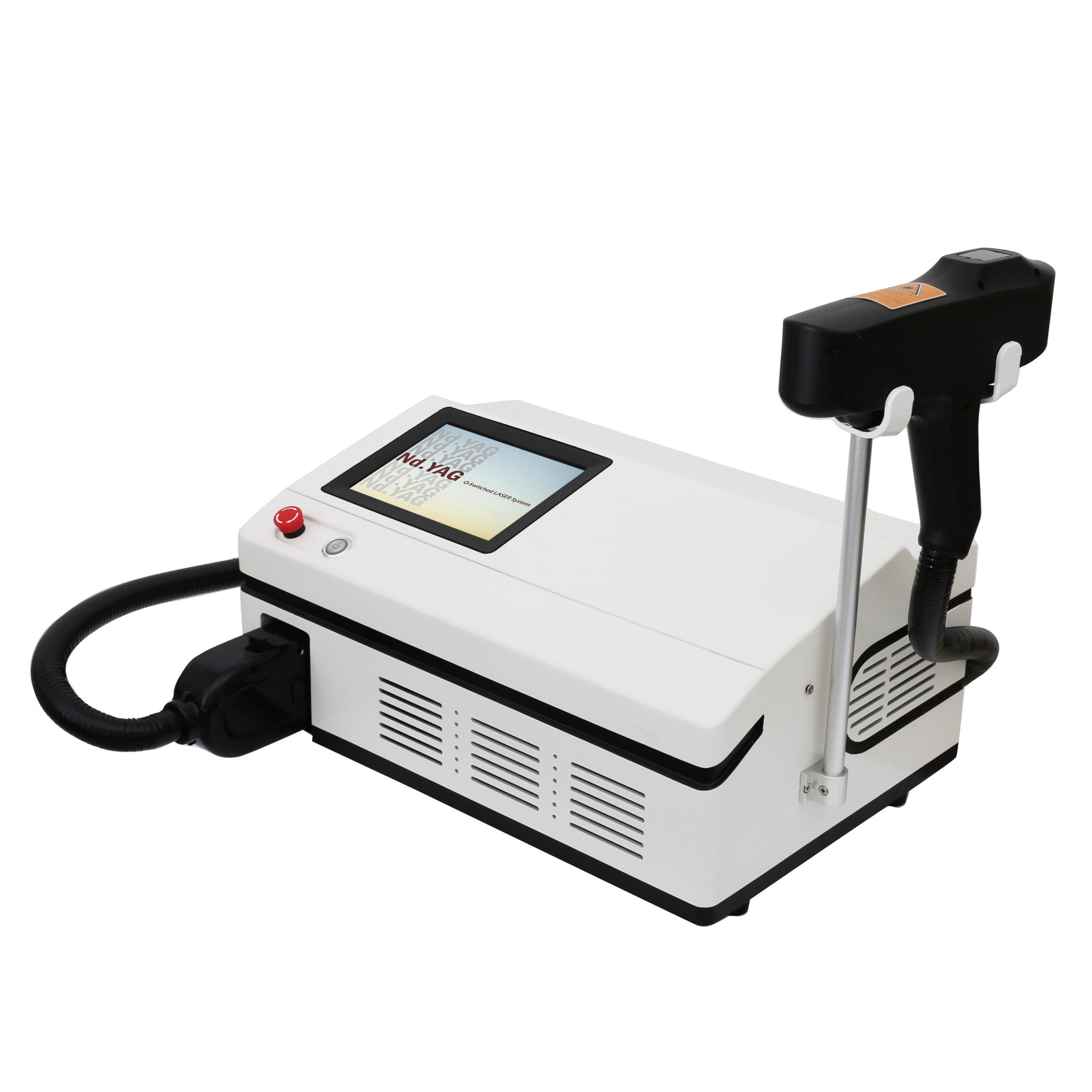
What Is A Q Switch Laser?
Q-switched laser therapy is a treatment method based on the principle of selective photothermolysis. It emits pulses of laser energy over an extremely short duration to target and “shatter” clusters of pigment in the skin. These clusters are broken down into tiny particles, which are then engulfed and cleared by macrophages, thereby achieving the therapeutic goal.
Depending on the wavelength, Q-switched lasers are categorized into several types: the 532 nm Nd:YAG laser, the 694 nm ruby laser, the 755 nm alexandrite laser, and the 1064 nm Nd:YAG laser.
Among these, the dual-wavelength (532/1064 nm) Nd:YAG laser is the most commonly used. The 532 nm wavelength has a shallower depth of penetration, making it suitable for treating superficial skin pigmentation, such as freckles, café-au-lait spots, and age spots.
In contrast, the 1064 nm wavelength penetrates deeper into the tissue, making it effective for treating deeper-seated pigment clusters, such as those found in Nevus of Ota or tattoos.

What Is Q-Switch Technology?
Q-switching is an effective method for generating high-energy, short-duration laser pulses. The “Q-factor”—or “quality factor”—is a metric used to evaluate the quality of an optical resonator within a laser. Q-switching works by compressing a continuous-wave laser output into extremely narrow pulses, thereby increasing the peak power of the light source by several orders of magnitude.
During the Q-switching process, the laser resonator is maintained at a high level of cavity loss, preventing laser oscillation because the threshold is too high. This allows a large number of particles to accumulate in the upper energy level. Once this population reaches a saturation point, the cavity loss is rapidly reduced to a very low value. Consequently, the energy stored by the particles in the upper energy level is converted into laser energy over a very short period, resulting in the emission of a high-intensity laser pulse.
Laser Q-switch Technology Types
Q-switched laser technology is mainly divided into active Q-switching technology (acousto-optic Q-switching and electro-optic Q-switching) and passive Q-switching technology.


1. Actively Q-switched laser
Mechanism: A modulator—such as an acousto-optic modulator—is introduced into the laser cavity to actively modulate the cavity loss.
Operating Principle: When radio-frequency (RF) power is applied, the modulator causes a portion of the laser beam to diffract and exit the cavity, thereby altering the cavity loss.
Operational Process: High energy is stored within the laser medium; subsequently, when the RF power is switched off, a laser pulse is formed and emitted.
1.1 Acousto-Optic Q-Switch (AO Q-Switch)
Acousto-optic (AO) Q-switching involves placing an acousto-optic medium within an optical resonator. In the absence of ultrasonic waves, the light beam passes through the medium unimpeded; the resonator’s Q-factor is high (low loss), facilitating the onset of laser oscillation.
When ultrasonic waves are applied, the density of the acousto-optic medium—and consequently its refractive index—undergoes periodic variation. This causes the light beam to deflect, resulting in a low Q-factor (high loss) for the resonator, which allows for the rapid accumulation of particles in the upper energy level. By controlling the ultrasonic waves, one can therefore modulate the intra-cavity loss, ultimately producing a pulsed laser output.

1.2 Electro-Optic Q-switch (EO Q-Switch)
Electro-optic (EO) Q-switching utilizes the electro-optic effect of a crystal; by applying a step-function voltage to the crystal, the reflection loss of photons within the optical cavity can be modulated. When a high voltage is applied to the crystal, the EO Q-switch is in a “closed” state, the resonant cavity is in a low-Q state, and the system is in an energy-storage state.
Once the population inversion within the resonant cavity reaches its maximum value, the high voltage applied to the crystal is abruptly removed. This shifts the resonant cavity into a high-Q state, resulting in the emission of a pulsed laser.

2. Passive Q-switched Laser
Mechanism: By incorporating a saturable absorber, the loss within the laser cavity is modulated based on the saturable absorption effect—a phenomenon where the material’s absorption depends on light intensity.
Operating Principle: The saturable absorber absorbs low-intensity light while allowing high-intensity light to pass through, thereby achieving passive loss modulation within the cavity.
Operational Process: Fluctuations in light intensity alter the absorption characteristics of the saturable absorber, which in turn affects the loss inside the laser cavity, leading to the formation and emission of laser pulses.

Passive Q-switching involves placing a saturable absorber (typically a solid-state material, such as Cr:YAG) inside a laser resonator. It utilizes the saturable absorption effect to periodically modulate the cavity loss, thereby generating pulsed laser output.
Initially, the spontaneous fluorescence within the cavity is weak, and the saturable absorber exhibits a high absorption coefficient—resulting in low optical transmission. Consequently, the cavity remains in a high-loss state, preventing the formation of laser oscillation.
As optical pumping continues, the population inversion builds up, and the fluorescence within the cavity intensifies. Once the light intensity reaches a specific threshold, the saturable absorber becomes saturated—effectively “bleaching”—which triggers the emission of a laser pulse. Subsequently, the optical field within the cavity weakens, and the saturable absorber reverts to its original absorptive state. This cycle then repeats, producing a continuous train of laser pulses.
Q-switched Laser Key Parameters
1. Peak Power & Average Power
- Average power = Single-pulse energy × Repetition frequency
- Peak power = Single-pulse energy / Pulse duration
Average power refers to the laser energy output per unit of time over a single repetition cycle.
Peak power refers to the maximum power reached by an individual pulse.
2. Pulse Width (Pulse Duration)
Pulse Width: The duration for which a single pulse is active.
It is defined as the sum of the time required for the photon count to rise from half-maximum to the peak, and the time required for it to fall from the peak back to half-maximum. It is measured in various scales, such as milliseconds (ms), microseconds (µs), nanoseconds (ns), picoseconds (ps), and femtoseconds (fs). The smaller the unit of time, the shorter the duration of the laser’s action.
With the same single pulse energy: the narrower the pulse width, the higher the peak power; the longer the pulse width, the lower the peak power.
3. Repetition Rate
Repetition rate: The number of laser pulses emitted at regular intervals per unit of time (equivalent to the number of times a pulse repeats within one second).
Given the same average power: a lower repetition rate results in higher single-pulse energy, while a higher repetition rate results in lower single-pulse energy.
Pros and Cons of Three Types of Q Switch
Comprehensive Comparison Summary Table
| Acousto-optic Q-switching | Electro-optic Q-switching | Passive Q-switching | |
| Single-pulse energy | Medium | Extremely high | Medium/Low |
| Repetition frequency | Very high | Low | Medium |
| Peak power | High | Very high | Medium |
| Driving voltage | Low | High | None |
| Control accuracy | High | Very high | Low |
| System complexity | Medium | High | Extremely low |
1. Advantages & Disadvantages of AO Q-switch
Core principle: Ultrasonic waves are used to form a diffraction grating within a crystal, deflecting light out of the resonant cavity.
Advantages
- High Repetition Rate: This is the primary advantage of an acousto-optic (AO) device. Unconstrained by the charging and discharging limits of capacitors, it can easily operate at frequencies ranging from tens of kHz to hundreds of kHz.
- Low Driving Voltage: It requires only an RF (radio frequency) signal—typically in the range of tens of volts—to drive it. Compared to systems requiring several kilovolts, this offers greater safety and simplifies circuit design.
- Long Lifespan and High Stability: With no moving mechanical parts and no exposure to high-voltage electrical stress, the device is highly durable and well-suited for long-term, continuous operation.
- Relatively Low Insertion Loss: In its “active” (operating) state, the light beam experiences minimal diffraction loss.
Disadvantages
- Limited extinction ratio (switching capability): It cannot completely block the light beam (typically achieving an extinction ratio of only 30–40 dB). This means that even in the “off” state, weak laser oscillation persists within the cavity, which limits the extent to which single-pulse energy can be increased.
- Diffraction losses: Even in the “on” state, a portion of the energy is required to facilitate the diffraction effect, resulting in some loss of optical intensity.
- Slower peak power: Because the switching capability is not as effective as that of electro-optic (EO) Q-switching, the upper limit for the accumulated population inversion is lower; consequently, the peak power of a single pulse is generally lower than that achieved with EO Q-switching.
2. Advantages & Disadvantages of EO Q-switch
Core principle: Utilizing the Pockels effect, the polarization state of light is changed by applying a half-wave voltage, which, in conjunction with a polarizer, blocks or allows light to pass through the optical path.
Advantages
- Extremely high extinction ratio: This is the standout feature of electro-optic (EO) modulators. They can block the optical path almost perfectly (with an extinction ratio exceeding 1000:1), allowing the laser medium to accumulate a very high degree of population inversion.
- Ultra-high peak power: Because they can “hold back” a greater amount of energy, the energy of a single pulse—once released—is exceptionally high, with peak power reaching the megawatt (MW) or even gigawatt (GW) range.
- Rapid switching speed: With a response time on the order of nanoseconds, they are ideally suited for generating pulses with extremely narrow pulse widths.
- High controllability: They allow for highly precise “external trigger” control, with minimal temporal jitter.
Disadvantages
- High-voltage driving: Typically requires high-voltage pulses (3 kV – 8 kV), which leads to complex circuitry, large physical dimensions, and potential safety hazards.
- Limited repetition rate: Due to the need to charge a capacitor via the driving circuit, the repetition rate is generally low (typically < 10 kHz), making it difficult to achieve the continuous, high-frequency output possible with acousto-optic (AO) devices.
- Temperature sensitivity: The birefringence of the crystal varies with temperature, necessitating precise temperature control; otherwise, the switching performance may be compromised.
- High cost: Both the high-voltage driver and the electro-optic crystal itself are relatively expensive.
3. Advantages & Disadvantages of Passive Q-switch
Core principle: A saturable absorber (such as a Cr:YAG crystal) is used; it absorbs light in its initial state (OFF), but becomes transparent instantaneously once the light intensity reaches a threshold (ON).
Advantages
- Simplest structure: Requires no external power supply, no drive circuitry, and no high voltage. It only necessitates the insertion of a crystal into the cavity.
- Low cost: Eliminates the need for expensive electronic control systems.
- Self-synchronization: Does not require an external trigger signal; it activates automatically once population inversion reaches a certain threshold, which simplifies system design.
- Compact size: Highly suitable for the design of miniaturized lasers.
Disadvantages
- Inability to precisely control timing: You cannot tell it “fire now,” it depends entirely on the light intensity accumulation inside the cavity, so the pulse output time will fluctuate.
- Low energy efficiency: The saturable absorber itself absorbs a portion of the laser energy (residual loss), resulting in a decrease in overall efficiency.
- Thermal effect problem: At high power or high frequency, the absorber is prone to heat generation, which can lead to performance degradation or even damage.
- Stability is generally poor: the saturation threshold will drift with temperature changes or crystal aging, resulting in unstable output energy.
Q-switch Laser Indications And Functions
- Epidermal pigmented lesions: freckles, sun spots, age spots, café-au-lait spots, etc.
- Dermal (deep-layer) pigmented lesions: Nevus of Ota, Nevus of Ito, acquired bilateral nevus-of-Ota-like macules (ABNOM), traumatic pigmentation, etc.
- Mixed-type conditions: melasma, etc.
- Facial rejuvenation: skin brightening, skin tone enhancement, reduction of fine lines, etc.
- Other: tattoos, permanent makeup (e.g., eyebrow tattoos), etc.
High-quality Q-switched Laser Selection
Liton Laser offers high-quality Q-switched Nd:YAG lasers. For active Q-switching, we provide both electro-optic and acousto-optic Q-switching technologies, with a pulse duration of 5 ns and available wavelengths of 532 nm, 755 nm, 694 nm, and 1064 nm.

For passive Q-switched lasers, we offer configurations featuring either one lamp with one laser bar or one lamp with two laser bars, capable of delivering pulse energies up to 3000 mJ. Available wavelengths include 532 nm, 755 nm (with a fractional/honeycomb-style delivery head), and 1064 nm; a carbon-peel (toner-assisted) treatment handpiece is also available. The pulse duration is 10 ns or 20 ns.


For more professional and detailed information, please check the Q-switched laser product category page.
Frequently Asked Questions
Q1: Is the treatment painful?
It utilizes contact cooling technology; the sensation is comparable to a light snap of a rubber band.
Q2: How many treatment sessions are required?
1–3 sessions for typical pigmented spots; 4–6 sessions for stubborn tattoos (depending on individual circumstances).
Q3: How should I care for my skin after the procedure?
Ensure proper physical sun protection and use medical-grade restorative facial masks.
Q4: Will the treatment leave any scars?
The laser offers precise targeting, affecting only specific colors. This minimizes the area of impact, so scarring is generally not a concern.
Q5: How long do the results last?
With proper sun protection, results can last 3–5 years (may vary by individual).
Conclusion
Technically, Q-switched lasers can be categorized into active Q-switching and passive Q-switching. Active Q-switching is further subdivided into electro-optic (EO) Q-switching and acousto-optic (AO) Q-switching.
In clinical practice, active Q-switched lasers offer shorter pulse durations and greater safety and stability, though they come at a higher cost. They are effective for treating various pigmentary disorders, as well as for the removal of eyebrow tattoos and other tattoos.
Passive Q-switched lasers are more affordable but are generally used only for tattoo removal (including eyebrow tattoos) and carbon-assisted skin resurfacing (carbon peels). They are less effective for treating pigmentary disorders.